
The Porcelain Tureen and Shadows of the Past: How "Surgery" in the Borderlands Failed to Kill Humanity
Blogs | 28 April, 2026 at 19:07 | 3,039 | Author: Olena Zelenina, Olexandr Sydorenko (caricature)
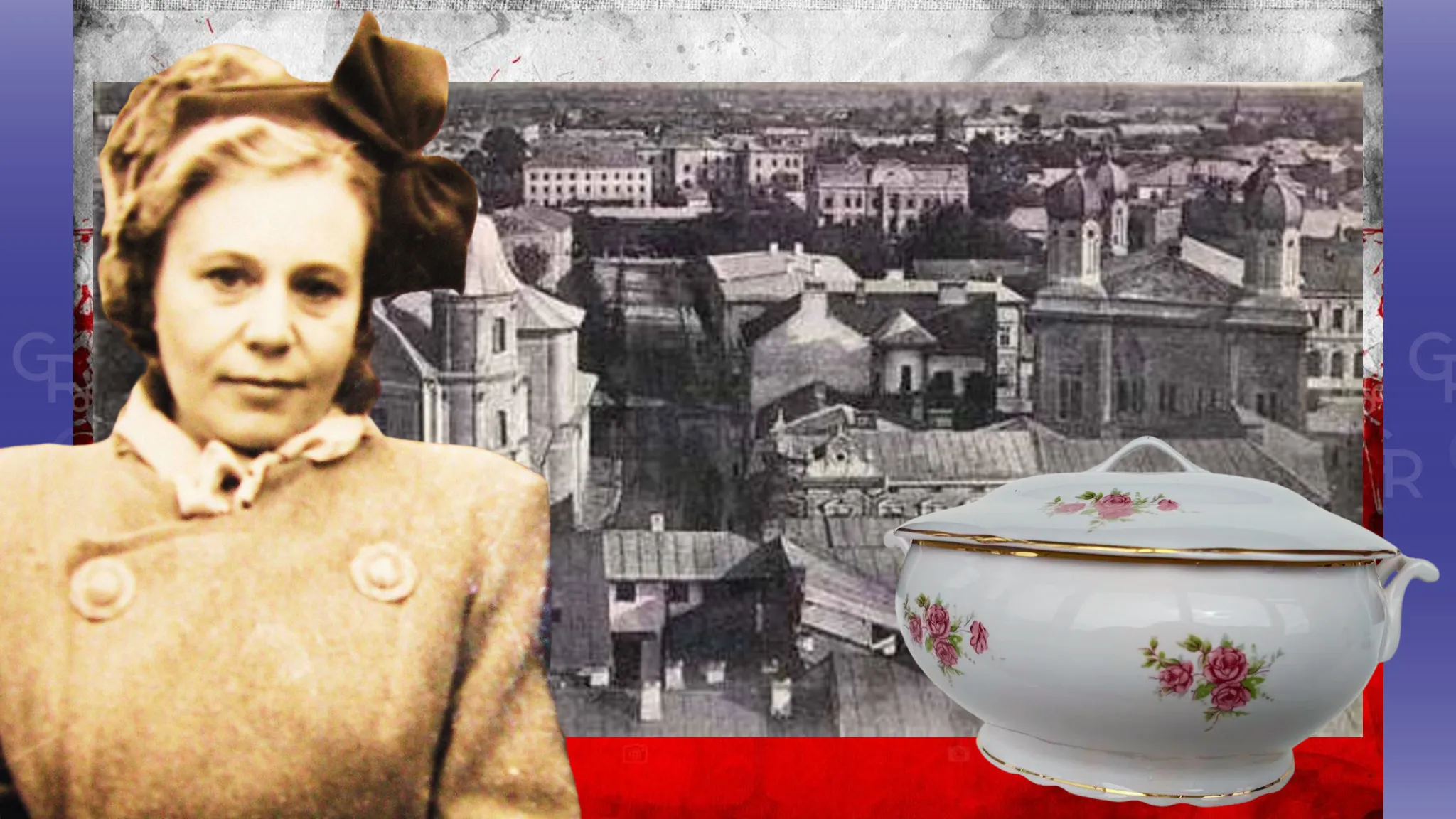
Collage by Olena Zelenina.
In my family, there is an object that has survived the change of eras, borders, and political regimes. It is an old porcelain tureen. It stands on the shelf — a silent witness to a time when human fate weighed less than the stroke of a pencil on a map in Yalta or Potsdam. To some, it is just tableware, but to me, it is a symbol of a great tragedy and an even greater nobility that endured in spite of everything.
1944. Stanislav was just recovering from the German occupation. My young parents arrived here on a work assignment. They settled in the very center, in an old tenement — a former apartment house where the high ceilings still remembered Austrian luster and the walls held the anxiety of recent battles. Their neighbors behind the wall were a Polish family.
Imagine: a foreign city, domestic upheaval, the aftertaste of war in the air. It was these Polish neighbors who became the ones who helped my mother settle in. They did not look at the "Easterners" as enemies. On the contrary, with a pure soul, they shared advice on how best to manage a household within these walls and how to arrange daily life. It was that simple, warm neighborly solidarity that is stronger than any propaganda.
And then came 1945. The Soviet authorities called it "voluntary evacuation," although in reality, it was a brutal deportation. People were torn out by their roots. Those same neighbors who just yesterday drank tea with my parents suddenly found themselves facing a choice: departure into the unknown or repression.
Official instructions promised the resettlers the right to take up to two tons of property per family. But what are two tons when you are leaving a home built over generations? In practice, people often found themselves in the echelons with only what they could hold in their hands.
When they were gathering their modest belongings — the little they were allowed to take into freight cars — they came to my mother. And they gave her this tureen. They gave it as a sign of remembrance, as a piece of their lost home that they did not want to surrender to the system.
This gesture was above politics. It was an act of quiet resistance to totalitarian tyranny, which tried to make nations quarrel and impose "collective responsibility" and hatred. Stalin and his Polish communist satellites acted like butcher-surgeons: they cut through the living, moving hundreds of thousands of people. Poles — from Stanislav and Lviv to the West; Ukrainians — during Operation Vistula — to former German lands or to camps like Jaworzno.
“Gromada” REFERENCE
The agreement between the Ukrainian SSR and the PKWN – the Polish Committee of National Liberation (Polish: Polski Komitet Wyzwolenia Narodowego — PKWN) laid the legal foundation for the eviction. Since the committee's headquarters were located in Lublin for a long time, it is often called the "Lublin Committee." It was the PKWN that, on September 9, 1944, signed those very "Lublin Agreements" on the mutual exchange of population with Nikita Khrushchev (who then represented the Ukrainian SSR). Formally, they agreed on "voluntary evacuation," but in fact, this document became a legal cover for the forced eviction of Poles from Ukraine and Ukrainians from Poland. The PKWN became the foundation upon which the communist regime in post-war Poland (the Polish People's Republic) was later built.
Although the documents emphasized the absence of coercion, in practice, conditions were created under which staying was impossible. According to the records of the special services of that time, the Polish population of Stanislav lived in the grip of fear: on one hand — the threat of repression and deportation to Siberia in case of refusal to go west; on the other — the bloody Ukrainian-Polish conflict that escalated at the end of the war.
The Stanislav Tragedy
The beginning of the conflict: in Stanislav, the first victim of the conflict was 30-year-old Jozef Guzik (July 1943), after which the cemetery on Sapieżyńska St. became a site of mass burials for victims of inter-ethnic confrontation.
The atmosphere in the echelons: memoirs of eyewitnesses paint horrific pictures: freight cars ("cattle cars"), unsanitary conditions, lice, and total uncertainty. The journey to the "new homeland" often lasted for weeks in inhuman conditions.
Deportation was carried out at moments when people had already sown the fields but had not yet had time to harvest, which effectively condemned the resettlers to a hungry existence in new places.
Operation Vistula:
The Totalitarian Knife
If the eviction of Poles from the USSR was part of the "cleansing" of territories, then Operation Vistula (April–July 1947) became the final chord in the attempt by the Polish communist regime to assimilate the Ukrainians of Zakerzonia. It was an action carried out as a "carbon copy" of Stalin's deportations of the peoples of Crimea and the Caucasus.
One of the most terrifying symbols of the action was the camp in Jaworzno. It was a real concentration camp for the civilian population, which differed from Nazi Auschwitz only by the absence of crematoria. Ukrainians — from peasants to intellectuals and priests — were subjected to torture, selection, and forced labor solely on an ethnic basis.
This was a deliberate policy. When we speak of the 'lessons of history,' we must remember: Jaworzno existed in parallel with the reconstruction of cities; it was the dark side of the 'new socialist life
Quote from a secret instruction:
"The main goal is assimilation in the new Polish environment... Do not use the term 'Ukrainian' in relation to these settlers."
This phrase reveals the essence of the crime — ethnocide through deportation and dispersion.
The logic of the regimes was simple: no people — no problems. They wanted to assimilate, dissolve, and erase identity.
I recently learned that many of the Poles deported from Stanislav and Lviv ended up precisely on the former German lands — in Wroclaw, Gdansk, and Szczecin. The state attempted to create a society without roots: some were driven from their ancestral homes, while others were settled into foreign, empty houses from which Germans had just been evicted. It was a dictators' chessboard, where every piece was stripped of the right to its own history.
…Last autumn I was in Wroclaw. Walking through its elegant streets, I caught myself thinking: perhaps somewhere here, in this crowd, pass the descendants of those same people from the Stanislav house.
Perhaps they just as carefully preserve some trinket taken from our shared past. And there is no hostility in this — only a deep, quiet sadness for the generations whose lives were broken by the millstones of dictatorships.
Today, when we are fighting for our freedom again, it is important to remember: the lessons of history exist not so that we infinitely measure whose grievance was greater. Polish? Ukrainian?
My porcelain relic becomes a symbol not only of past nobility but also of the fragility of the civilization we are now defending. The empire always comes with a "knife" to cut off memory, roots, and the bonds between people. Yet, humanity is something that this knife is unable to cut, no matter how deep it goes.
Today, imperial "surgery" is once again cutting through the living, and now this knife is poised over Donbas, Kharkiv, Odesa, Dnipro, Zaporizhzhia, Kherson, and Sumy. Only this time, instead of a pencil on a map, there are missiles and heavy artillery; instead of cattle cars, there are filtration camps and the forced deportation of our children.
The borderlands, which should have been a zone of exchange and solidarity, are once again being targeted by the heirs of those same "surgeons" to be turned into a "sanitary zone" or scorched earth. But my porcelain tureen reminds me: empires crumble, yet humanity survives.
It lives in my memory so that we may recognize the handwriting of a tyrant from the very first letters.
They exist so that we recognize the handwriting of a tyrant from the first letters. Totalitarian regimes always try to turn pain into a weapon and memory into a reason for enmity. Our task is to turn this pain into an experience of solidarity.
Our shared Ukrainian-Polish path today is the path of people who have outgrown old traumas. We must look into each other's eyes not through the sight of the past, but through the experience of a common struggle for a future where no one will ever again be given "two hours to pack."
And the porcelain tureen reminds me that even in the darkest of times, one can remain human. This is the main lesson we must learn so that history never repeats itself as farce or as tragedy.
"Gromada" talks about important news and topical topics, including useful podcasts and live videos about life in the communities of the Kharkov region, Ukraine and around the world.Our mission is to promote democratic values, independent journalism and human rights.

Comments
Some more relevant news for now